
Yin Yoga for Beginners: A Grounded, Meditative Practice

Updated: Oct 5

Yin yoga is a slow, meditative style of yoga that uses long-held passive floor poses to target connective tissue and calm the nervous system. Where most movement practices ask you to engage and strengthen, yin asks you to soften, stay, and let the body open at its own pace. Poses are typically held for several minutes; beginners usually start with shorter holds per shape.
The tissues this practice reaches are not the muscles you feel burn in a vinyasa class. Yin works on fascia, ligaments, and joint capsules, the deeper layers that tend to stay tight no matter how often you stretch dynamically. Long, still holds are what actually load these tissues.
Who is this practice for?
Beginners who want a gentle, accessible entry point into yoga
People who feel chronically tight despite regular movement
Athletes using yin for recovery and joint mobility
Contemplative practitioners drawn to a practice that doubles as seated meditation
Anyone carrying stress, restlessness, or a heaviness that active exercise does not seem to reach
There is something quietly spiritual about yin. Stillness, breath, and sustained attention are its primary tools, which makes it a natural companion for inner work, somatic grounding, and any path that values presence over performance.
Book through the free Spine App: searching and messaging cost nothing, and you book and pay in one step. Get it on App Store · Google Play
Table of Contents
Where yin yoga came from and the teachers who shaped it
Yin yoga’s roots reach back to the late 1970s in North America, when Paulie Zink, a martial artist and Taoist yoga practitioner, began teaching long-hold floor shapes drawn from Taoist and Chinese martial traditions. His approach was fluid and creative, blending animal-form movement with deep passive holds. Most Western practitioners never studied directly with Zink, but his foundational shapes traveled forward through the teachers who came after him.
Paul Grilley studied with Zink in the 1980s and became the figure most responsible for the modern form of yin yoga taught in studios today. Grilley integrated Western anatomy, particularly the concept of skeletal variation and how individual bone structure determines a person’s range of motion, with meridian theory drawn from Traditional Chinese Medicine. He began teaching workshops in the 1990s and his work gave yin yoga a coherent anatomical and energetic framework.
Sarah Powers trained with Grilley and brought a mindfulness and Buddhist psychology lens to the practice. She is widely credited with naming the style “yin yoga” and weaving breath awareness and meditative attention into the sequence structure. Her approach made the practice accessible to people who came from contemplative traditions as much as from physical yoga.
Bernie Clark extended the practice’s reach through writing and teaching. His book The Complete Guide to Yin Yoga and his website became primary reference points for teachers and students worldwide, offering detailed pose instructions, anatomical explanations, and meridian maps.
The lineage difference worth knowing: Zink’s original Taoist approach was more dynamic and creative, while Grilley, Powers, and Clark developed the quieter, anatomy-informed, floor-based style most people encounter today.
What yin yoga may support: physical and mental benefits
Yin yoga tends to support flexibility, joint mobility, nervous-system regulation, and the kind of meditative attention that makes other contemplative practices easier. These are realistic, grounded expectations, not promises.
Physical benefits:
Increased range of motion in hips, spine, and shoulders over time
Greater joint mobility through loading of joint capsules and surrounding fascia
Improved connective tissue health through regular, gentle stress and recovery
Recovery support for athletes by reducing stiffness between active training sessions
A sense of physical spaciousness that muscles-only stretching rarely produces
Mental and nervous-system benefits:
Reduction in state anxiety, particularly after individual sessions
A shift in the nervous system from reactivity toward presence
Deeper breath awareness that carries into daily life
A practical scaffold for meditation, since the long holds train sustained attention
Reduced sense of restlessness and mental noise after practice
An online yin yoga intervention over several weeks found reductions in state anxiety among participants, with decreases in situational anxiety observed after sessions. The research is promising, and the evidence base is still growing. Studies tend to be small, and outcomes for deeper trait anxiety are more mixed. Yin yoga is best understood as a supportive practice, one that accompanies clinical care rather than replacing it.
Yin yoga’s most consistent finding in the research is a reduction in state anxiety, the felt sense of tension in the moment, rather than a permanent change in baseline anxiety levels.
What the research says and its limits
The strongest available evidence for yin yoga points to short-term reductions in state anxiety and measurable session-level benefits from controlled interventions. A 10-week online study with 48 participants found that regular yin practice reduced state anxiety significantly by the end of the program, with participants also reporting immediate decreases in situational anxiety after individual sessions.
The proposed mechanisms are worth understanding:
Parasympathetic activation: long holds and slow breathing shift the autonomic nervous system toward a rest-and-digest state
Breath work: diaphragmatic breathing during holds directly influences heart rate variability and stress response
Connective tissue loading: sustained pressure on fascia may stimulate mechanoreceptors that signal safety to the nervous system
Finding | Detail |
State anxiety reduction | Significant decrease over 10-week online intervention (N = 48) |
Session-level anxiety | Immediate decreases in situational anxiety after individual sessions |
Trait anxiety | Mixed results; not consistently changed across studies |
Mechanism | Parasympathetic activation, breath regulation, connective tissue loading |
Limitations to keep in mind:
Sample sizes are small across most yin-specific studies
Several studies were conducted during the pandemic, which may have affected baseline anxiety levels
Outcomes for trait anxiety (long-term baseline) are inconsistent
More diverse, larger samples are needed before strong clinical claims can be made
This is general information, not medical advice. If you are carrying something that feels clinical, please work alongside a qualified healthcare provider.
How a yin yoga session actually works
A typical studio class runs for about an hour and includes a handful of poses. A home practice can be as short as 10–30 minutes with 2–4 shapes. Both are valid. Consistency matters more than duration.
A simple beginner home sequence (20–30 minutes):
Arrive in Constructive Rest (2 minutes): lie on your back, knees bent, feet flat. Let the breath settle.
Butterfly (3 minutes): sit with soles of feet together, fold forward gently, spine rounding naturally.
Caterpillar (3–4 minutes): legs long in front, fold forward from the hips, spine soft and curved.
Sphinx (3 minutes): lie on your belly, forearms on the floor, gentle backbend. Muscles soft.
Supine Twist (2–3 minutes each side): lie on your back, one knee crosses over to the opposite side.
Savasana (3–5 minutes): complete stillness. Let the nervous system integrate.
Props you will want:
A yoga mat
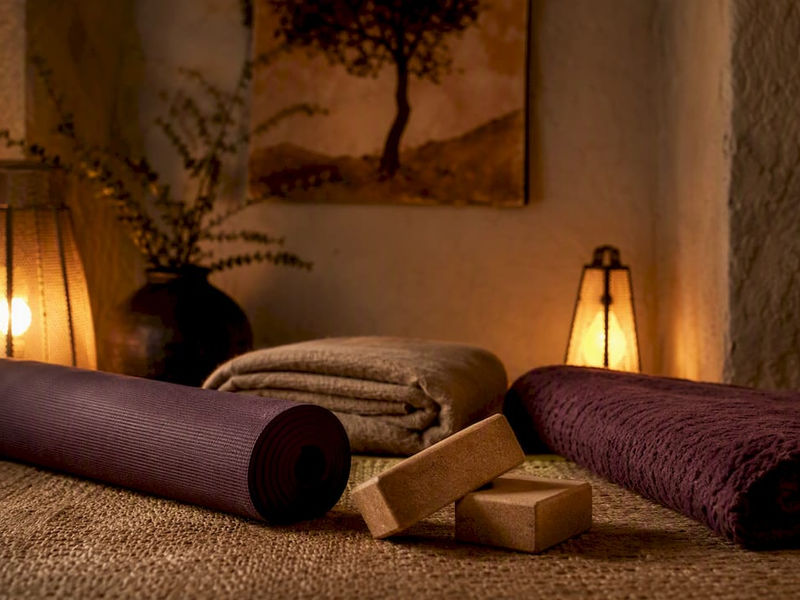
Two blankets or a bolster (for under hips, knees, or chest)
Two yoga blocks
A strap (for poses where the hands cannot reach the feet)
Beginner progression over four weeks:
Week 1: one 20-minute session, 2–3 minute holds, 3–4 poses
Week 2: two sessions, extend holds to 3–4 minutes where comfortable
Week 3: two to three sessions, add one new pose per session
Week 4: aim for three sessions, explore 4–5 minute holds on familiar shapes
Pro Tip: Move out of every pose slowly. After a long hold, connective tissue has been under sustained load and needs a moment to reorganize. Lie flat for 30–60 seconds between poses, especially after deep hip openers.
Sharp pain, electrical or nerve-like sensations, or joint pain that sharpens during a hold are signals to come out immediately. A dull ache or a deep stretch sensation at 4–5 out of 10 is the appropriate range. Mindfulness cues for breath and attention can help you stay present during longer holds without pushing past your edge.

Ten yin yoga poses to know, with targets and modifications
Pose | Target Area | Beginner Hold | Intermediate Hold | Key Prop / Mod |
Butterfly | Inner groin, lower back | 3 min | 5 min | Bolster under knees |
Caterpillar | Spine, hamstrings | 3 min | 5 minutes | Bolster across thighs |
Dragon (Low Lunge) | Hip flexors, quads | 2–3 min | 4–5 min | Block under front hand |
Sphinx | Lumbar spine, sacrum | 2–3 min | 4–5 min | Blanket under elbows |
Swan / Sleeping Swan | Hip rotators, IT band | 3 min | 5 min | Bolster under hip |
Frog | Inner groin, adductors | 2 min | 3–4 min | Blankets under knees |
Shoelace | Outer hips, glutes | 3 min | 5 min | Block under sitting bones |
Saddle | Quads, lumbar, ankles | 2 min | 4 min | Bolster behind knees |
Bananasana | Side body, IT band | 3 min | 5 min | No prop needed |
Legs Up the Wall | Hamstrings, lower back | 5 min | 10 min | Blanket under hips |
A few notes on specific poses:
Legs Up the Wall is the most accessible shape in the practice and a good starting point for anyone who feels uncertain about deeper holds. It is also excellent for nervous-system support after a long day.
Safety guidance: who should modify and how
Yin is gentle for most people, but long passive holds can aggravate certain conditions. The key is knowing what you are carrying before you begin.
Conditions that call for modification or medical guidance first:
Joint hypermobility or hypermobility spectrum disorder: long holds at end range can overstretch already lax ligaments. Keep a slight muscular engagement and stay well short of your maximum range.
Recent sprains, surgery, or acute injury: avoid loading the affected area until cleared by a clinician.
Active inflammatory joint conditions: flare periods are not the time for sustained joint loading. Practice during stable periods and with a teacher who understands your condition.
Acute disc injury or nerve compression: some yin poses place significant load on the lumbar spine or sciatic nerve. If you feel electrical, shooting, or nerve-like sensation, come out immediately and consult a clinician.
Pregnancy: many yin poses are accessible with modification, but deep hip openers and prone poses need adjustment. Work with a teacher experienced in prenatal yoga.
Modification checklist:
Use props under every joint that feels unsupported
Reduce hold times to 1–2 minutes when exploring a new shape
Keep a small amount of muscular engagement in hypermobile joints
Avoid end-range positions; stay at 60–70% of your maximum depth
Exit every pose slowly, pausing in a neutral position before moving on
Pro Tip: If you feel a sharp, electrical, or joint-specific pain at any point during a hold, that is not an edge to breathe through. Come out of the pose immediately, rest in a neutral position, and do not return to that shape in the same session.
This guidance is general information. When in doubt about what you are carrying, consult a qualified healthcare provider before beginning a new practice.
How to start yin yoga: a realistic first-month plan
The most common mistake beginners make is trying to hold poses too long too soon. Start shorter, stay consistent, and let the practice deepen gradually.
Four-week starter plan:
Week 1: one session of 20 minutes, 3 poses, 2–3 minute holds. Focus on Butterfly, Caterpillar, and Legs Up the Wall.
Week 2: two sessions per week. Add Sphinx and a Supine Twist. Extend holds to 3–4 minutes where comfortable.
Week 3: two to three sessions. Introduce Swan or Dragon. Begin noticing breath quality during holds.
Week 4: three sessions. Explore 4–5 minute holds on familiar shapes. Add a 5-minute Savasana at the end of every session.
Questions to ask a teacher before your first class:
How long have you been teaching yin specifically, and what training do you hold?
How do you approach safety for students with injuries or hypermobility?
Can you accommodate modifications during class?
What is the typical pace and how many poses does a session include?
Are props available, or should I bring my own?
Will the class include breath cues or a meditative component?
Online classes are a practical starting point. You can pause, adjust props, and control the environment. When you are ready for in-studio practice, the social and energetic dimension of a group class adds something that home practice cannot fully replicate. For online spiritual healing and class options, there are now many accessible formats.
Yin pairs naturally with other supportive practices: meditation, breathwork, Reiki, and somatic inner work all share yin’s orientation toward presence and listening. Short, regular sessions of 10–20 minutes, done consistently and with breath focus, can deliver many of the practice’s nervous-system benefits without requiring a full class commitment.
Key Takeaways
Yin yoga is a slow, floor-based practice that targets connective tissue through long passive holds, and its most consistent benefit is a reduction in state anxiety and a calmer nervous system.
Point | Details |
Hold times and target tissues | Beginners hold poses for shorter periods; intermediate practitioners for longer durations; the target tissues are fascia, ligaments, and joint capsules, not muscles. |
Research support | A 10-week online study (N = 48) found significant state anxiety reductions; session-level benefits are consistent, trait anxiety effects are mixed. |
Safety first | Long holds can aggravate hypermobility, acute injuries, disc problems, and nerve compression; use props, reduce depth, and consult a clinician when unsure. |
Starting frequency | Begin with one session per week, 20 minutes, and build gradually to two to three sessions over four weeks. |
Spiritual Network | Spiritual Network connects you to yin yoga teachers, somatic practitioners, and holistic guides online or near you through the free Spine App. |

Practice checklist before you begin: set aside 20–30 minutes, gather a mat, two blankets, and two blocks, set an intention to breathe slowly throughout, aim for a 4–5 out of 10 sensation, and come out of any pose immediately if you feel sharp or nerve-like pain.
Further reading and primary sources
The following resources are worth exploring if you want to go deeper:
What Is Yin Yoga? (WebMD)
Online yin yoga intervention reduced state anxiety (PMC article)
PubMed: Yin yoga anxiety intervention study (2024)
Yin yoga (Wikipedia)
Yin Yoga Poses: The 2026 Guide to Deep Tissue (PureYogaGuide)
10 Yin Yoga Poses That Benefit Your Mind and Body (Peloton blog)
Yin yoga guide: what is it, benefits, classes + more (Women’s Health UK)
Yin yoga: What it is, benefits & how to start (International Yoga Conference)
Use these as starting points for your own exploration. Spiritual Network connects seekers to local and online practitioners, classes, and spiritual podcasts through the free Spine App, where you can describe what you are looking for in your own words and find the support that fits your path.
Yin yoga and your path: what Spiritual Network offers

If yin yoga has opened something in you, or if you are drawn to the kind of stillness and inner attention it asks for, that is worth following. Spiritual Network is a directory and discovery platform for people seeking spiritual healers, energy workers, Reiki practitioners, somatic guides, and holistic practitioners, online or near you, when they are looking for support that goes beyond the physical.
Many people who find their way to yin yoga are also carrying something that a pose sequence alone cannot fully reach: grief that lingers, a restlessness that sleep does not fix, a longing for connection to something deeper. Spiritual Network is built for exactly that place. Through the free Spine App, you describe what you are going through in your own words and discover practitioners, events, retreats, and audio guidance that fit where you are right now.
This is not a replacement for medical care. It stands alongside it, the way yin yoga itself does: quietly, steadily, and with respect for what you are carrying. To find practitioners and classes that support your path, start with the free Spine App.
FAQ
What is the main purpose of yin yoga?
The main purpose of yin yoga is to load the deeper connective tissue, meaning fascia, ligaments and joint capsules, through long, passive floor holds of about 3–10 minutes; beginners usually start with 2–3 minutes per pose. Its aims are better joint mobility and a calmer nervous system, and because you stay still for so long, it also works as a natural doorway into meditation.
Is yin yoga difficult for beginners?
The physical shapes are accessible for most beginners, especially with props and shorter hold times of 2–3 minutes. The greater challenge is mental: staying still and present for several minutes at a time trains attention in a way that can feel unfamiliar at first.
How is yin yoga different from regular yoga?
Most yoga styles, including hatha and vinyasa, target muscles through active engagement and shorter holds. Yin yoga relaxes the muscles intentionally and holds poses long enough for the load to reach deeper connective tissue. The pace, intention, and target tissues are fundamentally different.
What is the hardest type of yoga?
Styles like Ashtanga and advanced Bikram are widely considered the most physically demanding, requiring significant strength, flexibility, and heat tolerance. Yin yoga’s challenge is different: not physical intensity, but the sustained stillness and mental presence that long holds require.
Can yin yoga support anxiety?
A 10-week online yin yoga intervention found significant reductions in state anxiety, with consistent session-level decreases in situational anxiety. Research is still growing, and yin yoga is best understood as a supportive practice alongside, not instead of, clinical care.
Where can I find a yin yoga class or teacher?
Yin yoga classes are offered by many yoga studios, community centers and online platforms, usually as 60-minute sessions with a handful of poses. If you want the practice as part of a wider spiritual path, Spiritual Network helps you find classes, somatic guides, retreats and audio guidance: describe what you are looking for in the free Spine App and see offers online or near you. Tell any teacher about injuries, hypermobility or pregnancy before the first class.
About Spiritual Network
Spiritual Network connects you with spiritual healers, energy workers and holistic guides worldwide, online or near you. Through the free Spine App you find them, message them, and book and pay for sessions directly. Founded by Sylvia Leifheit.
Written by the Spiritual Network Editorial Team.
Book through the free Spine App: searching and messaging cost nothing, and you book and pay in one step. Get it on App Store · Google Play
Comments