
Energy Healing Exhaustion Relief: Support Your Nervous System
- Sylvia

- 5 days ago
- 8 min read

Energy healing can meaningfully support chronic exhaustion, though it works best understood as nervous-system regulation and energetic clearing alongside medical care, not instead of it. When the body has been running on stress hormones for prolonged periods, rest alone often cannot release the tension locked in the nervous system. Energy work, including Reiki, somatic spiritual practices, and intuitive energy clearing, can signal safety to that system and create conditions for a gradual, genuine shift.
Exhaustion that sleep does not fix is often a sign the nervous system is stuck in a chronic stress response. Energy healing supports the release of that holding pattern by offering repeated safety signals the body can finally receive.
Three accessible practices you can try without equipment include supported rest with hands on heart and belly, grounding by noticing your surroundings, and slow exhale breathing to activate calming nervous system responses.
Always coordinate with your medical providers. Energy work is supportive, not a substitute for diagnosis or prescribed care.
Table of Contents
Why does energy healing help when conventional care hasn’t?
The short answer: energy work targets what conventional medicine often doesn’t measure. Practitioners observe that chronic exhaustion frequently involves a nervous system locked in a stress response, stored emotional weight, and what many describe as energetic debris, absorbed patterns from relationships, family lines, or prolonged periods of overwhelm. Rest cannot clear these layers on its own.
Reiki sessions, for example, can move the body into a parasympathetic state, softening chronic bracing and potentially supporting vagal-tone improvements over repeated sessions. Slower heart rate, deeper breath, a sense of the body finally letting go, these are the physiological shifts practitioners consistently describe. The somatic spiritual practices that accompany energy work reinforce this process between sessions.

Integrative and functional medicine experts also recognize that exhaustion is rarely a single-system problem. Mitochondrial function, immune regulation, and hormonal balance all contribute, and energy work is most effective when it runs alongside a proper medical or functional evaluation, not in place of one.
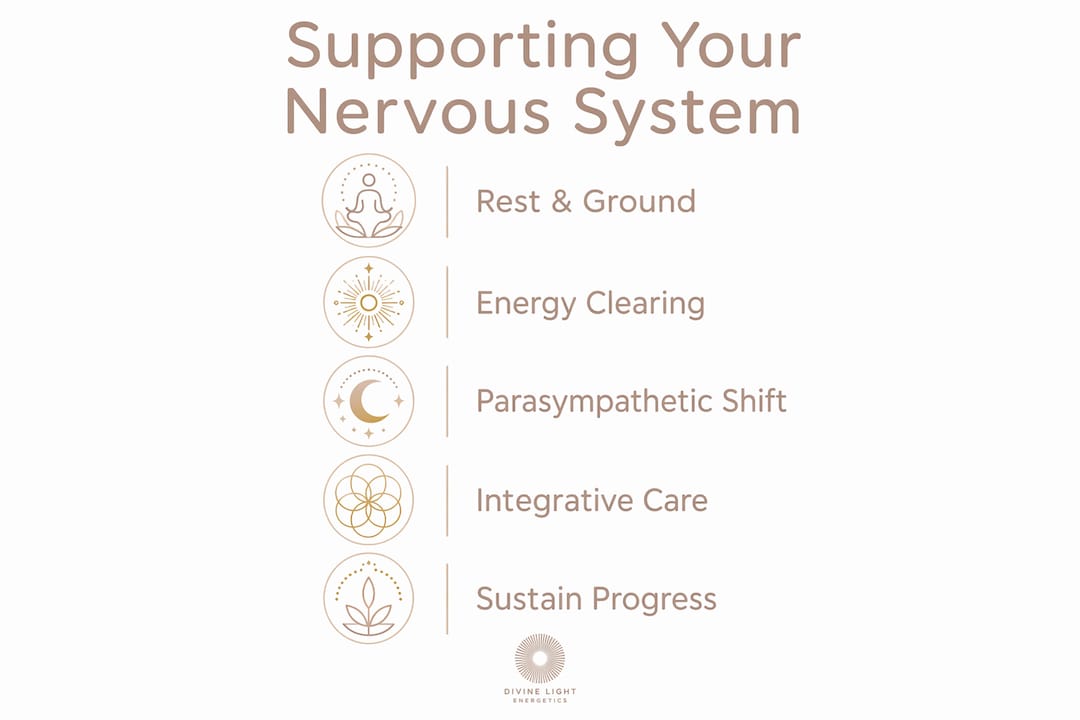
Safe energy-support practices you can try at home today
Pick one or two of these. Do them for 5–10 minutes and notice what shifts, if anything, in your energy, sleep, or emotional state over the following 24 hours. These are designed for fragile systems: low effort, lying down when possible, and never demanding exertion.
Supported rest with hands: Lie flat. Place your right hand on your heart, left hand on your lower belly. Breathe naturally. Stay for 5–10 minutes. This is the simplest vagal stimulation available to you.
5-4-3-2-1 grounding: Name five things you see, four you can touch, three you hear, two you smell, one you taste. Repeat slowly. This interrupts the stress loop and returns awareness to the present body.
Extended exhale breathwork: Inhale for four counts, exhale for eight. Six rounds. Do this lying down if standing feels like too much.
Root-chakra lying-down visualization: Lying on your back, imagine roots extending from the base of your spine into the earth. Breathe slowly and let the ground hold your weight. This practice is specifically recommended for fatigue conditions because it requires no physical effort.
A note on safety: Stay within your energy envelope. If a practice leaves you feeling worse the next day, that is a signal to shorten the duration, not push through. Post-exertional malaise (PEM) is a real risk for those with ME/CFS-related exhaustion; any practice that demands exertion or prolonged emotional flooding should be avoided entirely.
Try each practice two or three times per week to start.
Keep a simple log: note your energy level (1–10), sleep quality, and any emotional shifts after each session.
If you notice consistent worsening, pause and consult your medical provider before continuing.
When should you seek a practitioner for exhaustion relief?
Seek a practitioner when home practices bring partial relief but your nervous system still feels chronically stuck, when you sense there is something deeper you cannot reach alone, or when you want guided release beyond what solo tools can offer. You don’t need to be in crisis. Wanting support is enough.
What to expect in a typical session:
An intake conversation where you describe what you are carrying and what you are hoping for.
An energetic read or clearing, conducted in person or remotely, where the practitioner works with your field.
Nervous-system regulation practices woven into or following the clearing.
Aftercare suggestions: rest, hydration, gentle movement, and sometimes a follow-up timeline.
Sessions typically last a variable length of time, often around an hour, depending on practitioner and client needs. Many practitioners offer remote sessions, which can be especially useful when your energy is too low for travel. Frequency often starts periodically, then adjusts based on how you respond.
Questions to ask before booking:
What modalities do you work with (Reiki, energy clearing, shamanic, somatic)?
Do you offer remote sessions?
What does aftercare look like, and what should I expect in the days following?
How do you handle it if I feel worse after a session?
What is your training background?
Red flags to watch for:
Any practitioner who promises a cure or guarantees specific outcomes.
Pressure to stop prescribed medical care.
High-frequency upsells or packages pushed before you have had a single session.
Aggressive emotional purging techniques that leave you depleted rather than supported.
Cost varies widely across the US depending on modality, location, and experience level. Practitioners listed through directories are not vetted or endorsed by those platforms. Read how to describe what you are carrying to a healer before your first session.
How to combine energy healing with your medical care safely
Integration is where energy work becomes most effective. It complements diagnostic and biomedical interventions; it does not replace them. Functional and integrative medicine experts recommend pairing biological testing (mitochondrial markers, immune panels, hormonal assessments) with nervous-system support for the best outcomes. Energy work fits naturally into that second category.
What to do | Why it matters |
Tell your medical provider you are doing energy work | Keeps your care team informed and prevents conflicting advice |
Share your session log at integrative visits | Gives your provider real data on energy shifts and rest quality |
Use “what I am carrying” language, not clinical labels | Helps you describe your experience without over-medicalizing it |
Never stop prescribed care without a clinician’s guidance | Energy work supports; it does not substitute for medical management |
Ask your provider about mitochondrial and hormonal testing | These often reveal contributors that energy work alone cannot address |
A simple daily log to bring to appointments: date, energy rating (1–10), hours of rest, activities, and one line on any notable shift after a session. That record, kept for two to four weeks, gives both your medical provider and your energy practitioner something concrete to work with.
Readers in recovery from addiction may find that self-care tools built for pacing overlap usefully with the energy-envelope approach described here.
How to pace yourself and sustain progress over time
Realistic progress is gradual and non-linear. Expect small wins followed by days that feel like setbacks. That is not failure; it is how nervous-system restoration actually moves.
The energy envelope concept is central here. Your anaerobic threshold, the point at which exertion tips into depletion, is lower than you think when you are chronically exhausted. Heart-rate monitoring or a simple perceived-exertion check (scale of 1–10, staying below 5) can prevent the boom-and-bust pattern that worsens ME/CFS-related fatigue. Pushing through is not a virtue in this context.
Practice consistent supported rest daily, even on good days.
Set one boundary per week that protects your energy (a declined obligation, a shortened commitment).
Use gentle breathwork as a morning anchor, not a performance.
Notice what drains you and what restores you, and let that data shape your week.
Pro Tip: Track your perceived exertion during ordinary tasks, not just exercise. Cooking a full meal, a long phone call, or a difficult conversation can all push you past your threshold. Logging these alongside your energy practices reveals patterns that are otherwise invisible.
Self-compassion is not a soft add-on. Practitioners who work with chronic exhaustion consistently name it as a foundational practice, one that prevents the internal pressure that keeps the nervous system braced.
Key Takeaways
Energy healing supports exhaustion by regulating the nervous system and clearing energetic load, and it works best when coordinated with medical care and sustained through consistent, low-effort daily practices.
Point | Details |
Energy work as nervous-system support | Reiki and somatic practices signal safety to a locked stress response, supporting gradual release. |
Coordinate with medical care | Pair energy work with functional testing (mitochondrial, immune, hormonal) for the most grounded approach. |
Pace and protect your energy | Stay within your energy envelope; pushing through risks post-exertional malaise and setbacks. |
Progress is non-linear | Expect small wins and setbacks; self-compassion and consistency matter more than speed. |
Spiritual Network as your next step | Use Spiritual Network and the free Spine app to find energy workers, events, and audio guidance that fit where you are. |
What Spiritual Network offers people carrying exhaustion
If home practices have opened something in you and you are ready to go further, Spiritual Network is a doorway to practitioners, events, and audio guidance that can accompany you on your spiritual path.
[

The directory lists energy workers, Reiki practitioners, shamanic guides, and somatic spiritual healers across the US and online. The free Spine app lets you describe what you are carrying in your own words and surfaces the practitioners, events, and podcasts that fit your situation. Sylvia’s articles and audio resources on the platform offer guidance you can absorb at your own pace, on the days when even a session feels like too much.
To search, try terms like “Reiki,” “energy clearing,” or “somatic spiritual practice.” Practitioners are not vetted or endorsed by the platform; use the questions in this article to evaluate anyone you consider booking. Your privacy matters, and you can review how the platform handles your information on the data protection page.
When you are ready, Spiritual Network is where the next door opens.
FAQ
Can energy healing actually help with chronic exhaustion?
Energy healing can support chronic exhaustion by helping regulate the nervous system and releasing stored energetic load. It works best alongside medical care, not as a replacement for it.
How many sessions does it take to notice a difference?
Progress is gradual and non-linear; some people notice shifts after one or two sessions, while others see meaningful change over three to six months of consistent practice and sessions.
Is energy healing safe if I have ME/CFS or post-exertional malaise?
Gentle, low-effort practices like supported rest and root-chakra visualization are generally safe, but avoid any technique that demands exertion or prolonged emotional intensity, and always consult your medical provider first.
What should I ask an energy healer before my first session?
Ask about their modalities, whether they offer remote sessions, what aftercare looks like, and how they respond if you feel worse afterward. Avoid any practitioner who promises a cure or pressures you to stop medical care.
How do I find an energy healer for exhaustion in the US?
Spiritual Network’s directory and the free Spine app let you search by modality (Reiki, energy clearing, somatic practice) and connect with practitioners online or near you across the United States.
Comments