
What Does Spiritual Integration Mean for Healing
- Sylvia

- Jun 28
- 7 min read

Spiritual integration is defined as the process of embodying spiritual insights into daily life so they shape behavior, relationships, and identity over time. Without this step, spiritual experiences remain fleeting highs that produce no lasting change in character or conduct. The gap between a profound moment of clarity and actually living differently is where most people get stuck. Spiritual integration closes that gap. It is the difference between knowing something is true and letting that truth quietly reorganize how you move through the world. Spiritualnetwork exists precisely for people at this threshold, connecting seekers to energy workers, spiritual guides, and healing practitioners who support this kind of deep, grounded work.
What does spiritual integration mean as a process?
Spiritual integration is the bridge between a peak spiritual experience and its sustained, practical application in everyday life. A meditation retreat, a grief breakthrough, a Reiki session, or a moment of sudden clarity can all produce genuine insight. Integration is what happens next.
The transition from insight to lived growth is the defining difference between a meaningful experience and actual spiritual development. Most people skip this step entirely. They carry the insight in their minds but never translate it into behavior. The result is a collection of beautiful realizations that change nothing.
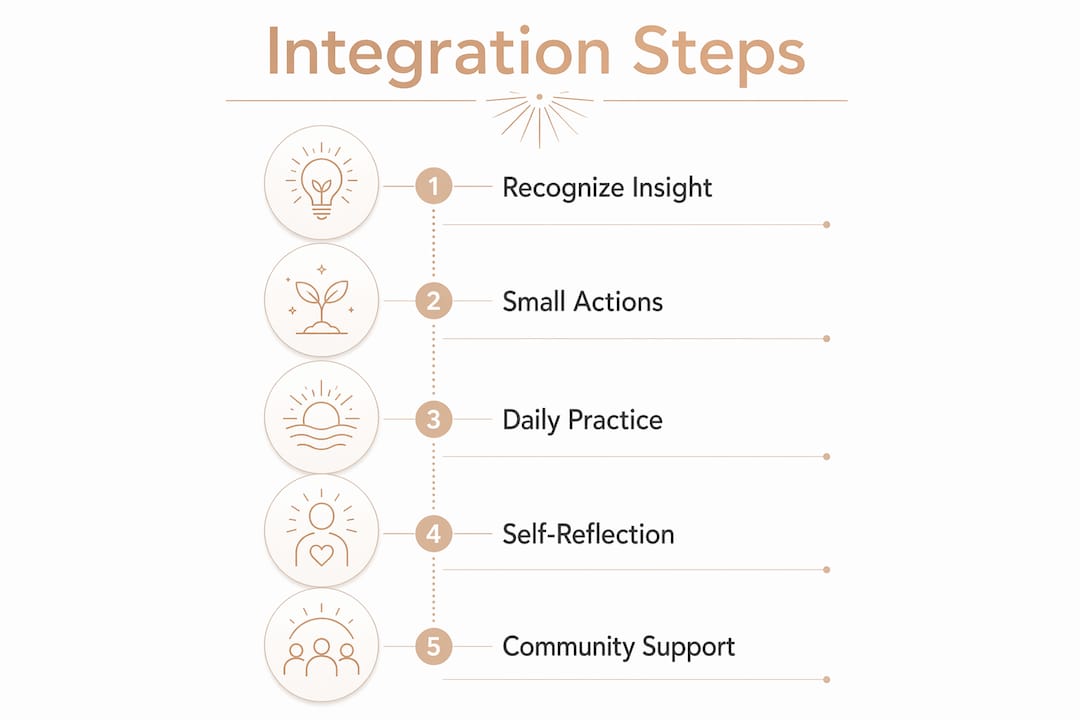
Effective integration follows a clear sequence. Practitioners who work with this process regularly describe it in three to five stages:
Capture the insight. Write it down immediately after the experience. Do not rely on memory. A single sentence is enough.
Identify one behavior it calls for. Ask: if this were true, what would I do differently today? Name something specific and small.
Run a micro-action experiment. For seven days, practice that one small behavior. A 10-minute weekly ritual focused on one insight anchors change without triggering overwhelm.
Reflect on what shifted. At the end of the week, notice what felt different. Resistance is data, not failure.
Invite community witness. Share what you noticed with one trusted person. External witness accelerates internal anchoring.
Consistency matters more than intensity here. One small action repeated daily does more than a weekend immersion followed by weeks of inaction.
Pro Tip: Start with the smallest possible version of the behavior change. If the insight is “I need more stillness,” begin with two minutes of silence each morning, not a 30-day silence practice. Small wins build the neural pathways that make bigger shifts possible.
How does spiritual integration heal the fragmented self?
Embodiment is the visible expression of spiritual knowledge. When integration is working, spiritual insights stop living only in the mind and begin showing up in how you speak, respond, set limits, and treat yourself. That shift is the meaning of spiritual wholeness in practice.

The fragmented self is a useful way to describe what happens when parts of your inner life are cut off from each other. Trauma, grief, and chronic stress all create this kind of fragmentation. Spiritual experiences often touch those cut-off parts directly. Integration is the work of welcoming them back.
Signs that integration is occurring include:
Responding with patience in situations that previously triggered reactivity
Setting clearer limits without guilt or over-explanation
Feeling compassion for yourself during moments of failure
Noticing when you are performing versus when you are present
Making decisions that align with your stated values rather than your habitual fears
The contrast between intellectual understanding and lived experience is sharp. You can read every book on forgiveness and still feel rage the moment someone wrongs you. Spiritual knowledge becomes meaningful only when it influences daily decisions and relationships. That is the test embodiment applies to every insight.
Self-reflection and emotional awareness are the two primary tools for healing fragmentation. Journaling, somatic awareness practices, and honest conversation with a trusted guide all support this process. The goal is not to eliminate difficult emotions but to stop being controlled by them.
What challenges arise during spiritual integration?
Integration can feel destabilizing, and that disorientation is normal. When a spiritual experience shifts your sense of identity, the nervous system does not automatically update to match. The old patterns persist. The new awareness feels fragile. This gap creates confusion that many people mistake for regression.
Spiritual integration therapy and transpersonal psychology offer specialized support for exactly this experience. These approaches treat post-awakening distress as a developmental signal, not a pathology. Methods like EMDR address body-held experiences that talk therapy alone cannot reach. This kind of support helps people move beyond old identities without forcing the process.
The most common pitfall is spiritual bypassing. Spiritual bypassing occurs when insights are used to avoid difficult emotions rather than face them. A person might use the idea of “non-attachment” to avoid grieving a loss, or invoke “everything happens for a reason” to skip the anger that a genuine wrong deserves. True integration requires facing shadow alongside light.
Challenge | What it looks like | How to address it |
Spiritual bypassing | Using insight to avoid emotion | Engage the emotion directly before returning to the insight |
Ego resistance | Reverting to old patterns after initial progress | Use micro-actions to avoid triggering the ego’s threat response |
Nervous system lag | Feeling “off” even when intellectually clear | Allow time; backsliding is normal and part of retraining |
Isolation | Processing alone without witness | Seek community, a guide, or a trusted friend |
Forced urgency | Pushing for rapid transformation | Trust the pace of the process; presence matters more than speed |
Pro Tip: When integration feels stuck, resist the urge to add more practices. Instead, slow down and ask: “What am I avoiding right now?” The answer is usually where the real work is waiting.
What are effective spiritual integration techniques?
Practical techniques make the difference between integration as a concept and integration as a lived reality. The most effective practices are simple, repeatable, and grounded in daily life rather than reserved for special occasions.
Mapping insights to mundane life domains is one of the most reliable methods. Take a spiritual insight and ask where it applies in your ordinary week: at work, in your closest relationships, in how you handle money or time. Specificity prevents the insight from staying abstract.
Core techniques that support embodiment include:
Journaling with a single question. Each morning, write one sentence answering: “What truth am I living today?” This keeps insight active rather than archived.
Honest communication practice. Speak one true thing each day that you would normally soften or avoid. Integration requires bringing inner truth into outer expression.
Somatic check-ins. Pause three times daily and notice where tension lives in the body. The body often knows before the mind does that something is out of alignment.
Mindful micro-actions. Choose one insight each week and design one tiny behavior that expresses it. Repeat it daily for seven days.
Community and witness. Share your process with at least one person who can reflect it back to you. Community support creates external anchors for change that internal practice alone cannot provide.
Weekly reflection ritual. Set aside 10 minutes at the end of each week to review what shifted, what resisted, and what you want to carry forward.
Balance matters as much as practice. Integration does not require dismantling your life. The goal is to let new awareness quietly influence existing structures rather than blow them up. Stability is a feature of good integration, not a sign that nothing is changing.
Key Takeaways
Spiritual integration is the daily practice of translating spiritual insight into lived behavior, requiring patience, micro-actions, and honest self-reflection to produce lasting change.
Point | Details |
Integration closes the gap | Spiritual experiences only produce lasting change when actively embodied through consistent daily behavior. |
Micro-actions anchor insight | A single small behavior practiced for seven days does more than intense but infrequent effort. |
Embodiment is the test | Integration is visible when insights show up in communication, limits, and emotional responses. |
Bypassing blocks growth | Using spiritual ideas to avoid difficult emotions prevents genuine integration and must be recognized directly. |
Support accelerates the process | Community witness, spiritual guides, and specialized therapy all help anchor change that inner practice alone cannot sustain. |
Integration is slower than awakening, and that is the point
People come to spiritual work expecting the awakening to be the hard part. In my experience, it is the integration that demands the most from you. The insight arrives in a flash. Living it takes years.
What I have seen repeatedly is that the nervous system needs time to learn that a new way of being is safe. Integration retrains the nervous system to embody new truths, and initial backsliding is not failure. It is the system testing whether the change is real. When you understand that, setbacks stop feeling like evidence that you are broken and start feeling like evidence that something is actually shifting.
The people who integrate most deeply are not the ones who push hardest. They are the ones who stay present with what is uncomfortable without running from it or spiritualizing it away. Integration is an act of self-trust, allowing awakened truths to unfold naturally with compassion and patience rather than forcing a timeline.
My honest advice: stop measuring your integration by how enlightened you feel and start measuring it by how you behave on a difficult Tuesday. That is where the real work shows up. And that is where real growth lives.
— Sylvia
Spiritualnetwork: a place to support your integration work
Integration rarely happens in isolation. Having the right guide, community, or practice at the right moment can shift months of stagnation into genuine movement.

Spiritualnetwork connects you to spiritual healers, energy workers, Reiki practitioners, shamanic guides, and intuitive counselors who understand this kind of work. Whether you are processing a spiritual awakening, working through grief that conventional care has not reached, or simply ready to go deeper, the platform helps you find the support that fits where you actually are. The free Spine app lets you describe your experience in your own words and surfaces practitioners, events, podcasts, and workshops matched to your path. Spiritualnetwork is not a medical service. It stands alongside care, not in place of it.
FAQ
What does spiritual integration mean in simple terms?
Spiritual integration means taking insights from spiritual experiences and living them out in daily behavior, relationships, and decisions. It is the process of turning what you know spiritually into how you actually act.
How long does the spiritual integration process take?
There is no fixed timeline. Integration is an ongoing process that unfolds over months and years, not days. Consistency with small daily practices matters far more than the speed of change.
What is spiritual bypassing and why does it block integration?
Spiritual bypassing is using spiritual ideas to avoid facing difficult emotions or shadow aspects of yourself. It blocks genuine integration because real embodiment requires engaging with darkness, not transcending it prematurely.
What is spiritual integration therapy?
Spiritual integration therapy is a specialized approach that supports people experiencing distress or disorientation after spiritual experiences. It draws on transpersonal psychology and body-based methods like EMDR to help people move forward without pathologizing the experience.
How do I know if spiritual integration is working?
Integration is working when spiritual insights begin showing up in your behavior: clearer limits, more patience, honest communication, and decisions that align with your values rather than your fears.
Recommended
Comments