
Spiritual Healing for Depression: What You Need to Know
- Sylvia

- 10 hours ago
- 7 min read

Spiritual healing for depression is defined as a set of complementary practices that address the emotional, energetic, and existential dimensions of depressive illness alongside conventional care. Where medication and talk therapy target symptoms, spiritual healing works on what often goes untouched: the grief that has no name, the exhaustion that sleep cannot reach, the quiet sense that something deeper is asking to be heard. Recognized bodies such as the National Center for Complementary and Integrative Health (NCCIH) and the Institute of Noetic Sciences have studied these approaches, and a growing body of clinical research supports their role as meaningful adjuncts to standard mental health treatment. This article explains what spiritual healing involves, what the evidence shows, and how you can begin safely.
What is spiritual healing for depression?
Spiritual healing for depression is not a single method. It is a category of practices that work with energy, meaning, intention, and inner awareness to support emotional recovery. The standard clinical term for its most researched form is spiritually integrated psychotherapy, which combines psychological care with attention to a person’s spiritual life, values, and sense of purpose.
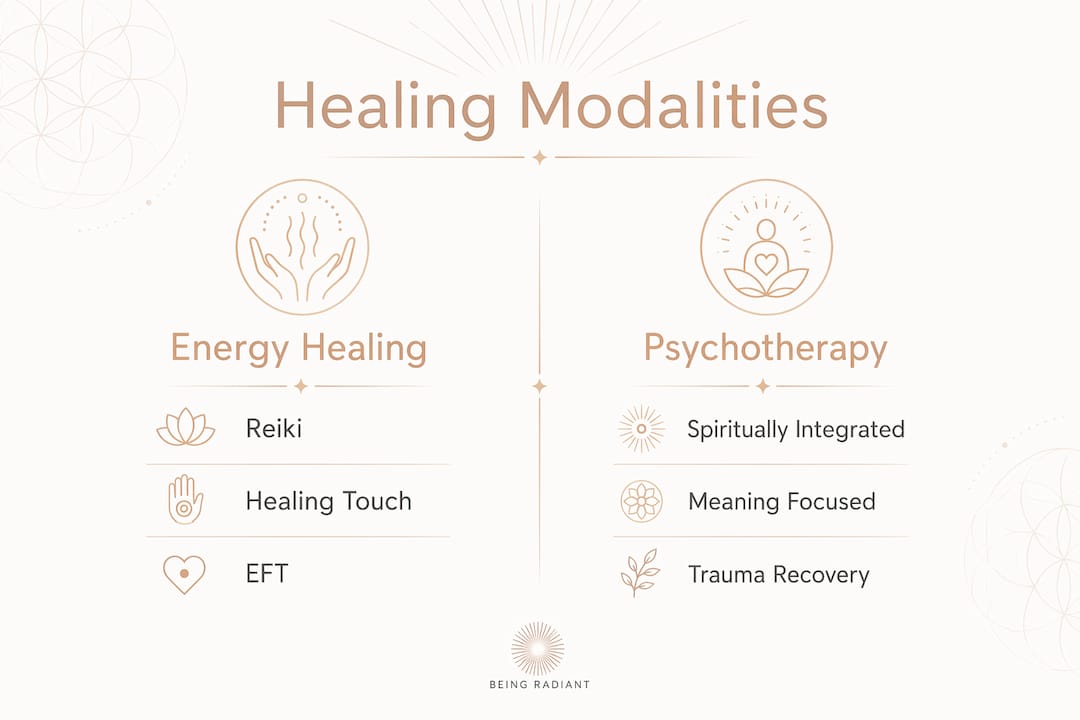
Energy healing modalities form the practical core of many spiritual approaches. Reiki works with the body’s biofield, the subtle energy field that practitioners believe surrounds and permeates living tissue. Healing Touch uses intentional hand movements to support energy flow. Emotional Freedom Technique (EFT), sometimes called tapping, combines acupressure points with verbal acknowledgment of emotional pain. The NCCIH classifies these into “veritable” energies, which are measurable, and “putative” energies such as biofields, which are not yet measurable by standard instruments. Over 200 distinct energy healing types exist across these two categories.

Spiritual healing also works through meaning. Spiritually integrated psychotherapy focuses on helping people find purpose, develop resilience, and reconnect with what matters to them. This is especially relevant in depression, where the loss of meaning is often as painful as the loss of energy or mood.
The Institute of Noetic Sciences describes the goal of a healing session as bringing a person into a relaxed, receptive state where their own internal capacity for recovery can activate. The practitioner creates a supportive field. The person does the healing. That distinction matters, because it places agency back with you.
Pro Tip: Before your first session, write down one thing that feels unresolved, not just sad or heavy, but specifically unresolved. Bringing that intention into a session gives the work a clear direction.
What does the evidence say about spiritual healing and depression?
The evidence is real, and it is growing, though it is not yet definitive. A 2025 pilot randomized controlled trial found that spiritual healing sessions were a beneficial adjunct to usual care for adults with moderate depression. Participants reported high satisfaction and strong adherence. Sessions typically ran 30–60 minutes and addressed the whole person, not just presenting symptoms. High adherence in a pilot trial signals that people find the approach meaningful enough to continue, which is itself a significant finding in depression research.
Spiritually integrated psychotherapy carries some of the strongest evidence. A 2025 review published in psychiatric literature found that this approach significantly reduces depressive symptoms and suicidal ideation, particularly in people who identify as religious or spiritual. The mechanism is meaning-making: when people can locate their suffering within a larger framework of purpose, existential distress loses some of its grip.
“Viewing depression as a gateway for existential growth transforms healing from symptom management to meaning discovery, increasing therapy engagement and long-term resilience.”
One case study within that same research involved a young woman recovering from trauma. Spiritually integrated care helped her develop spiritual qualities, a sense of service, and a renewed relationship with meaning. Her improvement was significant. The case illustrates what medication alone often cannot reach: the existential layer of suffering.
The table below summarizes the current state of evidence across key modalities.
Modality | Evidence level | Primary benefit noted |
Spiritually integrated psychotherapy | Moderate, growing | Reduces depressive symptoms and suicidal ideation |
Reiki and biofield therapies | Preliminary | Supports relaxation and emotional regulation |
EFT (tapping) | Emerging clinical trials | Reduces anxiety and emotional distress |
Spiritual healing sessions (general) | 2025 pilot RCT | High satisfaction, beneficial adjunct to usual care |
The NCCIH notes that energy-based modalities are generally considered safe but lack large-scale proof of efficacy for depression specifically. That gap does not mean they do not work. It means the research has not yet caught up with the experience of the many people who find genuine relief through these practices.
What are practical spiritual healing techniques for depression?
Spiritual healing is not passive. Research is clear that sustained daily practices produce deeper shifts than single sessions alone. The following techniques are accessible, evidence-informed, and safe to practice alongside clinical care.
Meditation. Even ten minutes of breath-focused or loving-kindness meditation each day can quiet the mental noise that depression amplifies. Consistency matters more than duration.
Energy healing sessions. Working with a Reiki practitioner or Healing Touch guide can support the relaxed, receptive state that activates your own self-regulation. These sessions work best when you arrive with an open intention rather than a fixed expectation.
EFT (tapping). Tapping on acupressure points while naming a specific emotional pain is one of the most accessible self-administered techniques. It requires no equipment and can be done in five minutes.
Prayer and contemplative practice. For those with a faith tradition, prayer offers a structured way to externalize suffering and reconnect with a sense of being held. For those without a tradition, contemplative sitting serves a similar function.
Journaling with spiritual intention. Writing is not just processing. When approached as a spiritual act, journaling becomes a way of listening to what is asking to be healed. Try writing to your grief directly, as if it has something to tell you.
Spiritual community engagement. Isolation deepens depression. Connecting with a spiritual community that fits your values provides belonging, shared meaning, and gentle accountability.
These techniques work best when they accompany, not replace, clinical treatment. A therapist, psychiatrist, or physician remains an essential part of the picture. Spiritual practices address layers of depression that medication often cannot reach, particularly existential suffering, but they do so most effectively alongside conventional care.
Pro Tip: Keep a short daily log of which practices you used and how you felt afterward. Patterns emerge over two to three weeks that help you identify what genuinely moves the needle for you.
What cautions should you know before starting spiritual healing?
Spiritual healing carries real benefits, and it also carries real risks if approached without awareness. Understanding these cautions protects you and helps you get the most from the work.
Spirituality can cut both ways. A 2025 narrative review found that negative religious coping, including guilt, shame, or the belief that depression is a spiritual punishment, can worsen distress rather than ease it. Spiritual frameworks vary enormously across cultures and personal histories. What supports one person may burden another.
Spiritual healing is not a substitute for clinical care. Replacing medication or therapy with spiritual practices alone is a common and genuinely dangerous mistake. The best outcomes come from a collaborative approach where healers and clinical providers work in the same direction.
Healing crises are real. Sessions can surface suppressed emotions. Tears, unexpected anger, or a temporary intensification of heaviness are recognized signs that trapped energy is moving. Experienced guides anticipate this. If you are new to energy work, ask your practitioner how they handle emotional releases before you begin.
Practitioner autonomy matters. A good spiritual healer respects your beliefs, does not impose their own framework, and supports your right to make your own choices. If a practitioner pressures you toward a specific doctrine or discourages your clinical care, that is a clear signal to find someone else.
Spiritual integration takes time. A single session opens a door. Deeper shifts require ongoing personal practice and a willingness to sit with what surfaces. Expecting immediate resolution sets up disappointment and can cause people to abandon practices that would have helped them over time.
Understanding what spiritual support looks like in practice helps you enter the work with realistic expectations and genuine readiness.
Key Takeaways
Spiritual healing for depression works best as a sustained, complementary practice that addresses meaning, energy, and emotional depth alongside clinical care.
Point | Details |
Spiritual healing is complementary | It supports conventional treatment; it does not replace medication or therapy. |
Evidence is growing | A 2025 pilot RCT confirmed spiritual healing as a beneficial adjunct for moderate depression. |
Meaning-making is central | Spiritually integrated psychotherapy reduces depressive symptoms by helping people find purpose and resilience. |
Daily practice deepens results | Single sessions open a door; sustained meditation, journaling, and energy work create lasting shifts. |
Caution is part of the practice | Negative religious coping and emotional releases are real risks that informed guidance can navigate safely. |
Finding support through Spiritual Network
If something in this article resonated, you are not alone in looking for support that goes beyond what a prescription or a standard therapy session can reach.
[

Spiritual Network connects people with energy healers, intuitive guides, Reiki practitioners, and holistic workers, online or near you, when they are ready to explore what conventional care has not yet touched. The platform also offers spiritual healing podcasts and audio guidance you can return to at your own pace. For those who want a more personal starting point, the free Spine App lets you describe what you are going through in your own words and surfaces the healers, events, and practices that fit your situation. Visit Spiritual Network to begin, and download the Spine App to find the connection that feels right for where you are now.
FAQ
What is spiritual healing for depression, exactly?
Spiritual healing for depression is a set of complementary practices, including energy healing, spiritually integrated psychotherapy, and meaning-centered techniques, that support emotional recovery alongside conventional treatment. It addresses existential and energetic dimensions of depression that medication alone often does not reach.
Can spiritual practices actually help with depression?
Research supports their role as adjuncts. A 2025 pilot RCT found spiritual healing sessions beneficial for moderate depression, and spiritually integrated psychotherapy has been shown to reduce depressive symptoms and suicidal ideation in spiritual or religious clients.
What is energy healing and how does it relate to depression?
Energy healing is a category of practices, including Reiki, Healing Touch, and EFT, that work with the body’s biofield to support relaxation and emotional regulation. For depression, these practices can activate the body’s own self-regulation capacity and ease the emotional weight that clinical treatment does not always address.
Is it safe to use spiritual healing instead of antidepressants?
Replacing clinical care with spiritual healing alone is not recommended. The strongest outcomes come from using spiritual practices alongside medical and psychological treatment, not as a substitute. Always maintain your relationship with your clinical provider while exploring spiritual support.
How do I find a spiritual healer for depression support?
Spiritual Network connects people with energy workers, Reiki practitioners, and holistic guides online or in person. The free Spine App lets you describe your experience in your own words and matches you with practitioners and practices suited to where you are. Practitioners listed on the platform are not vetted or endorsed; use your own discernment and consult your clinical provider as part of the process.
Comments