
9 Astrology Reading Types: Match Your Question to the Right One


Most people asking about astrology reading types already have a specific need in mind, not a general curiosity. If you want self-understanding, a natal chart reading is your starting point. If you need timing, look at transits, solar returns, or progressions. If a relationship is the question, synastry or composite charts apply. For a single, urgent yes-or-no question, horary works without any birth data at all, and electional astrology helps you choose a date to act. Accurate birth time matters for almost everything except horary.
TL;DR:
Accurate birth time is essential for natal, transit, solar return, progressed, synastry, composite, and locational readings but not required for horary or electional astrology.
Specific, time-sensitive questions are best addressed through horary astrology, which provides quick answers without needing birth data.
Relationship insights come from either synastry, which compares two charts, or the composite, which treats the partnership as a separate entity.
Choosing between psychological and predictive astrology depends on whether you seek inner self-awareness or external timing, as both are valid approaches.
In-person, phone, or online sessions vary in pace and interaction, but the type of reading and preparation are more important than the format.
The Main Astrology Reading Types at a Glance
Each reading type answers a different kind of question, and knowing which one matches your intention saves you time, money, and a session that leaves you more confused than when you started. Here’s the shortlist practitioners generally work from:
Natal (birth chart) reading — Interprets your innate blueprint using planets, signs, houses, and aspects at the moment you were born. Best for self-understanding and pattern recognition. Sessions typically run 45 to 90 minutes. Requires exact birthdate, time, and place.
Transit reading — Looks at where planets are moving right now against your natal chart. Answers “what’s active in my life this month or this year?” Best for people navigating a transition. Sessions run 30 to 60 minutes. Requires birth data for accuracy.
Solar return reading — A chart cast for the moment the Sun returns to its exact natal position, usually near your birthday. Answers “what’s the theme of my coming year?” Best for annual check-ins. Sessions run 30 to 60 minutes. Requires birth data.
Progressed chart reading — Uses a symbolic timing method where each day after birth represents a year of life. Answers questions about inner psychological shifts. Best for those tracking long developmental arcs. Requires accurate birth time.
Synastry reading — Overlays two people’s charts to examine relationship dynamics. Answers “how do we affect each other?” Best for couples or close partnerships. Requires both people’s birth data.
Composite reading — Builds a single midpoint chart representing the relationship as its own entity. Answers “what is this relationship, at its core?” Best for long-term partnerships assessing shared purpose.
Horary reading — Casts a chart for the exact moment a question is asked, no birth data needed. Answers a specific, time-bound question. Best for urgent decisions. Sessions can run as short as 20 to 30 minutes.
Electional reading — Selects an auspicious date and time for an event you’re planning. Answers “when should I do this?” Best for weddings, launches, or signings.
Locational (astrocartography) reading — Maps how your natal planets interact with different locations on Earth. Answers “where might I feel most supported or most challenged?” Best for people considering a move.
Notice how birth time separates the two camps: natal, transit, solar return, progressed, synastry, composite, and locational readings all lean on it. Horary and electional do not.
What a Natal Reading Actually Shows You
A natal chart is a fixed map drawn from the sky at your exact moment of birth, and it does not change. What shifts is your relationship to it. Most sessions start with what practitioners call the Big Three: your Sun (core identity), Moon (emotional inner world), and Rising sign (how you meet the outer world). From there, an astrologer layers in the houses, which represent life areas, and the aspects, which show how planets talk to one another.
What you walk away with is not a prediction. It’s pattern recognition: recurring themes you can carry into self-reflection, ritual, or simply watching your own cycles with more patience. A grounded reading treats your chart as something to work with, not a verdict on who you are. Consistency across several factors, not any single placement, tends to point to the themes that run deepest in a life. Sessions run anywhere from 30 minutes for a quick overview to 90 minutes or more for a full natal chart reading.
Transits, Solar Returns, and Progressions: Reading Timing, Not Identity
If your question is “what’s happening right now, or what’s coming,” you’re in timing territory. Transits track where the planets sit today against your natal chart, useful for questions like “is this a good window for a career change?” A solar return chart, cast for the moment the Sun returns to its natal position near your birthday, sketches the coming year’s overall tone. Progressions use a symbolic method (a day for a year) to trace slower, inner psychological development, the kind of shift you feel building for years. (The well-known Saturn return, by contrast, is read as a transit.)
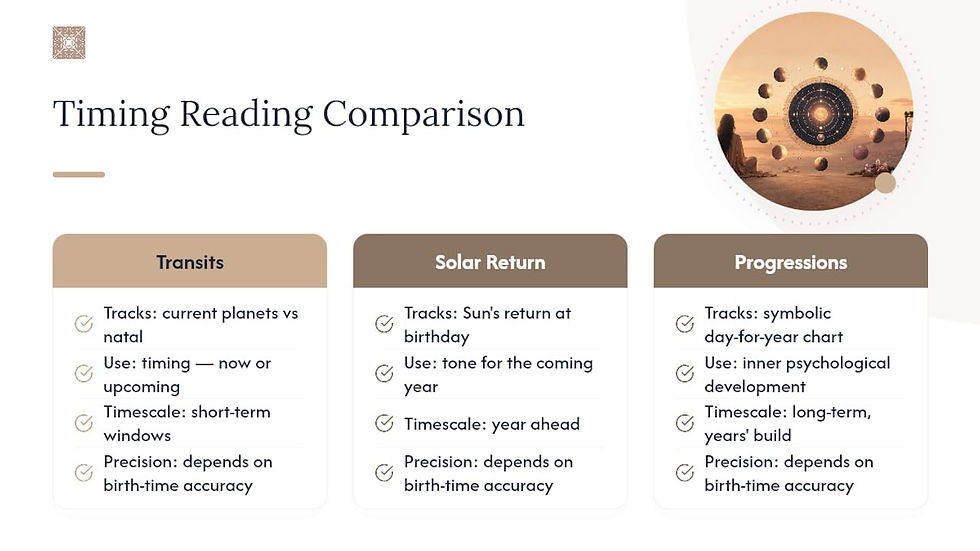
None of these methods predicts fixed outcomes. They point to periods of activation or focus, and precision depends heavily on how accurate your birth time is.
Synastry Versus Composite: Two Ways to Read a Relationship
Synastry overlays two people’s charts side by side to see how they interact, useful for questions like “why do we clash over money but connect so easily emotionally?” A composite chart takes the midpoints between both charts and treats the relationship as its own entity, answering a different question: “what is this partnership actually here to do?”
Both require accurate birth data for each person. If one partner can’t attend the session, most astrologers can still work from birth details alone, though having both people present allows real-time questions. Choose synastry when you want to understand dynamics between two individuals; choose composite when you want to understand the relationship’s identity.
Horary and Electional Astrology: When You Need an Answer Now
Horary astrology casts a chart for the exact moment you ask your question, no birth data required at all. It works best with specific, well-formed questions: “Will I hear back about this job by Friday?” not vague ones like “What does my future hold?” Electional astrology works in reverse: instead of answering a question, it helps you choose a favorable date to start something, a wedding, a move, a signature on a contract.
Horary sessions can move fast, sometimes 20 to 30 minutes, since there’s no birth chart to build first. Electional work usually takes longer because the astrologer is scanning a calendar window for the right combination of planetary placements.
Beyond Western Astrology: Sidereal, Chinese, and Human Design
Tropical astrology, the Western system most common in the United States, aligns the zodiac to the seasons. Sidereal astrology, used in Vedic traditions, aligns it to the actual position of constellations, which shifts your sign placements compared to tropical readings. This is part of the ongoing astrology versus numerology conversation too: numerology draws meaning from birth numbers and names rather than planetary positions, so the two systems answer different kinds of questions entirely.
Chinese astrology organizes life through a twelve-year animal cycle and five elements, offering a different lens on temperament and timing. Human design, a newer hybrid system, combines astrology, the I Ching, and chakra theory into a “bodygraph” showing energy type and decision-making style. A human design reading answers questions closer to “how am I built to make decisions?” than “what will happen next?” People weighing human design versus astrology should know they’re not competing systems so much as different maps for different questions. If you’re curious about human design basics, most practitioners recommend starting with your energy type and authority, similar to how astrology beginners start with the Big Three. Check what tradition a practitioner trains in before booking, since the approach shapes the entire session.
How to Choose a Reading and Prepare for the Session
Getting real value from a single session comes down to preparation, not luck. Walk in with clarity, and you’ll walk out with something useful.
Name your question first. “I want to understand myself” points to natal. “I want to know if this is the right time” points to transits or electional. “I have one specific question” points to horary.
Confirm your birth data. You’ll need date, exact time, and place of birth for anything except horary. A birth certificate or hospital record is the most reliable source; without accurate time, house placements and your Ascendant become unreliable.
Pick the reading type that matches your question, using the shortlist above.
Set your session length expectations. Quick horary questions can run 20 to 30 minutes; full natal work often runs 60 to 90 minutes.
Ask the astrologer beforehand what system they practice (tropical, sidereal, or another), what tools they use, and what you’ll receive afterward, notes, a recording, or a written summary.
Watch for red flags: any astrologer who promises a guaranteed outcome, makes medical claims, or tells you a placement means something is permanently “bad” is overstepping what the practice can honestly offer.
Pro Tip: Ask if you can record the session or request a short written summary afterward. Chart details are dense, and having something to revisit later turns a one-hour conversation into a resource you can return to for months.
Psychological Astrology Versus Predictive Astrology
Psychological astrology treats your chart as a map of inner tendencies, useful for reflection, self-awareness, and understanding recurring emotional patterns. A psychological reading might explore why you keep attracting the same kind of conflict, or how your Moon sign shapes what makes you feel safe. It draws heavily from natal work and treats the chart as something to grow into over time rather than something that dictates events.
Predictive astrology, by contrast, focuses on timing and outer events, when a career shift might open up, when a relationship phase might intensify. It leans on transits, solar returns, and progressions, and it’s the branch most closely associated with the “what’s going to happen” question.
Neither approach is more legitimate than the other. They’re different tools for different needs. Someone processing grief or trying to understand a long-standing pattern may get more from a psychological session. Someone planning a business launch or wondering about a specific window of opportunity may get more from predictive work. Many practitioners blend both in a single session, starting with the psychological layer, your Sun, Moon, and Rising, before moving into what’s currently active through transits. When you book, it helps to say directly which lens you’re hoping for. A session framed as psychological but delivered as a string of predictions (or the reverse) tends to leave people unsatisfied, not because the astrologer did anything wrong, but because the expectations didn’t match.
In-Person, Phone, or Online: Choosing Your Format
The format you choose shapes the feel of the session more than most people expect. In-person readings offer a slower, more embodied pace. You’re sitting across from someone, and there’s room for pauses, for the conversation to breathe. Some seekers find this format especially grounding for a first natal chart reading, when the material can feel dense and personal.
Phone readings strip away visual distraction and let you focus purely on what’s said. Several practitioners note that clients open up more candidly by phone, maybe because there’s no eye contact to manage while processing something emotionally loaded.
Online video readings, now the most common format by far, combine convenience with the option to screen-share your chart in real time, watching the astrologer point to specific placements as they talk through them. This format also makes it far easier to work with a practitioner trained in a tradition you specifically resonate with, rather than settling for whoever happens to practice near you. Whichever format you choose, the birth data and reading type matter more than the medium.
The Tools Astrologers Use Beyond the Basic Chart
Beyond the standard wheel of planets, signs, and houses, many astrologers draw on more specialized methods depending on your question. Astrocartography maps your natal planets onto a world map, showing lines where a specific planet’s energy is more pronounced in different locations, useful for anyone weighing a move or already sensing that a certain city fits differently. Declinations track how far north or south a planet sits relative to the celestial equator, offering a secondary layer some astrologers use to spot connections that longitude-based aspects miss.
Fixed stars, ancient reference points beyond the moving planets, get folded into some natal and predictive readings to add nuance to a chart, particularly around career or public-facing themes. Not every practitioner uses these tools, and that’s fine. A solid natal or transit reading doesn’t require astrocartography or fixed stars to be meaningful. But if your question specifically involves relocation or you’re drawn to a more layered interpretation, ask ahead of time whether your astrologer works with these methods, since not everyone does.
Finding a Practitioner Who Understands Your Approach

There’s a particular kind of relief in sitting down with someone who already speaks your spiritual language, whether that’s tropical astrology, a Vedic sidereal approach, or a human design chart reading layered alongside your Sun and Moon. You don’t have to explain your framework from scratch or translate your beliefs into terms that feel foreign. You just start where you actually are.
Spiritual Network connects seekers to astrologers, energy workers, and other holistic practitioners, both online and in person, alongside sessions, workshops, retreats, and events happening worldwide. A free app helps personalize that search: describe what you’re carrying and what kind of reading you’re hoping for, and it surfaces practitioners and offerings that fit your specific situation, rather than a generic match.

Spiritual Network doesn’t claim to vet or certify practitioners, and nothing here replaces medical or mental health care. It’s a way to find spiritual support that sits alongside whatever else you’re already doing for your well-being. If you’re not sure where to start, try searching with your reading type, your goal, and your preferred tradition together, something like “natal reading, career direction, Vedic,” or “synastry, relationship clarity, tropical.” The more specific your search, the more likely you’ll land on someone whose approach actually matches your path. You might also browse how to connect with a spiritual community that fits for more on finding practitioners aligned with your background before you book anything.
Selected Further Reading
List of astrological traditions, types, and systems (Wikipedia)
Types of astrological readings: natal, transit, and beyond (Astrological Authority)
Natal chart reading: what each layer of your chart reveals (Synthesis Astrology)
FAQ
What are the main types of astrology charts?
The most commonly used chart types are natal, transit, solar return, progressed, synastry, composite, horary, electional, and locational (astrocartography), each built to answer a different kind of question.
What are the three main types of astrology?
Most traditions break down into three broad approaches: natal (identity and blueprint), predictive (timing, through transits and returns), and relationship-based (synastry and composite), though horary and electional add a fourth practical category for specific questions and decisions.
What are the four types of horoscopes?
Horoscopes are typically published by timeframe: daily, weekly, monthly, and yearly, each reflecting current transits against general sun-sign patterns rather than a personalized chart reading.
Do I need my exact birth time for a reading?
Yes, for anything involving houses or your Ascendant, including natal, transit, solar return, progressed, synastry, composite, and locational readings; horary is the exception, since it uses the moment the question is asked instead.
What’s the difference between synastry and composite readings?
Synastry overlays two people’s charts to show how they interact with each other, while composite astrology builds one combined midpoint chart representing the relationship as its own separate entity.
How is human design different from astrology?
Human design blends elements of astrology, the I Ching, and chakra theory into a bodygraph focused on energy type and decision-making style, while traditional astrology centers on planetary placements at your birth moment; many people use both as complementary lenses rather than choosing one.
How do I find an astrologer who matches my beliefs or tradition?
Ask directly whether a practitioner works in tropical, sidereal, or another system before booking, and use a platform like Spiritual Network, where you can search by reading type and tradition to find someone whose approach actually fits how you see the sky.
Explore practitioners directly at Spiritual Network to find someone whose approach fits how you see the sky.
About Spiritual Network
Spiritual Network connects you with spiritual healers, energy workers and holistic guides worldwide, online or near you, through the free Spine App. Founded by Sylvia Leifheit.
Written by the Spiritual Network Editorial Team.
Comments